Crop Scouts Head Into North Dakota Wheat Fields This Week
North Dakota's annual wheat tour sends crop scouts into fields this week to count heads and kernels, producing the first hard yield estimates of the US spring wheat season.
- Entered
- Plot
- 1.2 ha
- Record
- 471 words
- Walk-through
- 2 min
DrillSprayHarvestCurrent stage
Agronomist’s notes
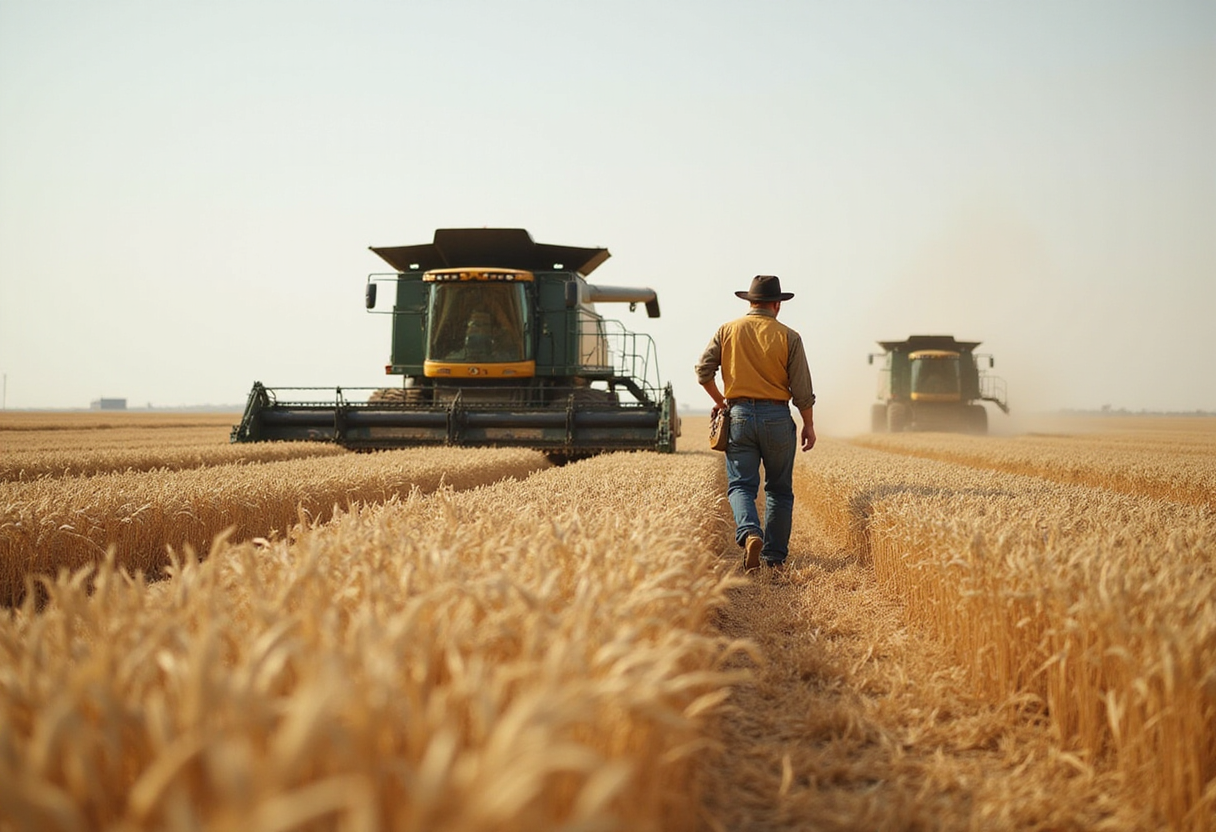
- Crop scouts began assessing North Dakota wheat fields this week as part of the state's annual wheat tour, DTN Progressive Farmer reports.
- Scouts use standardized head and kernel counts to generate field-level yield estimates that are aggregated into a statewide projection.
- The tour's results typically move wheat futures, as they provide the first ground-truthed yield data of the US spring wheat and durum season.
Crop scouts take to North Dakota wheat fields this week, as the state's annual wheat tour gets underway to put hard numbers on a crop that markets, millers and growers have so far only been able to estimate from the roadside.
The tour, reported by DTN Progressive Farmer, sends teams of scouts — agronomists, grain analysts, farmers and reporters — into fields across North Dakota to assess yield potential, crop condition and disease pressure before harvest. For a state that sits at the heart of US spring wheat and durum production, the results of these walks move markets. Traders watch the tour's yield estimates closely, and a surprise in either direction can reprice wheat futures within hours of the numbers being released.
The method is deliberately unglamorous. Scouts stop at representative fields, count heads and kernels, measure row spacing, and plug the figures into standard formulas to generate field-level yield estimates. Those individual stops are then aggregated into route averages and, ultimately, into a statewide projection. The discipline matters: because scouts use the same counting protocols year after year, the tour builds a comparable dataset that shows whether this season's crop is running ahead of or behind the benchmark.
This week's findings will answer three questions. First, how much did this season's planting conditions, weather and any disease or pest pressure cost the crop in yield terms. Second, whether crop development is on schedule for harvest or lagging — a lagging crop stays exposed to late-season risk longer. Third, whether quality indicators such as test weight and protein look likely to hold up, which matters as much as bushels for durum and hard spring wheat growers selling on protein premiums.
For farmers outside North Dakota, the tour's numbers carry weight well beyond the state line. North Dakota's spring wheat and durum production shapes national supply figures, and the tour's yield estimates often serve as the first credible, ground-truthed read on the crop after months of condition ratings based on visual scoring. Condition scores can mislead; head counts and kernel counts are harder to argue with.
Growers with wheat still in the field should treat the tour results as a marketing signal as much as an agronomic one. A tour estimate that comes in below trade expectations typically supports futures prices and can open a selling window. An above-expectation number tends to do the opposite. Either way, the figures give sellers a concrete data point to set offers against, rather than sentiment.
Watch for the tour's final statewide yield estimate and the breakdown by crop type once scouts complete their routes. Market reaction in the following trading sessions, and any follow-up field reports from growers and extension agronomists, will show whether the tour's numbers hold up as harvest equipment rolls.
via Google News: harvest report wheat (Source)
More from Tom Whitfield
Show full bio
Staff writer covering marketplaces and e-commerce at Arable Wire.
38 articles
Nearby records
- CL 77Kansas wheat harvest day six: yields hold above expectationsOctober 3, 2026
- VM 80Kansas Wheat Harvest Day 5: Yields Reported Across Barton CountySeptember 29, 2026
- FZ 86Oklahoma Wheat Harvest 12%-14% Complete Amid Uneven Crop ConditionsOctober 3, 2026
- EM 59Kansas Wheat Harvest Day 8: Yields Hold Steady as Cutting Reaches Central FieldsOctober 3, 2026
- RK 67U.S. Winter Wheat Harvest Outpaces Average PaceOctober 3, 2026