Nebraska corn yields fall 20-30 bushels as tar spot meets weather
Nebraska corn harvest hit 37% complete by Oct. 19 with yields down 20-30 bushels per acre, as tar spot, heat and lodging combine to squeeze the state's crop.
- Entered
- Plot
- 1.9 ha
- Record
- 771 words
- Walk-through
- 4 min
DrillSprayHarvestCurrent stage
Agronomist’s notes
- Nebraska field corn yields are 20-30 bushels per acre below last season, while USDA projects a state average of 188 bushels per acre.
- Corn harvest was 37% complete on Oct. 19, below the five-year average of 48%.
- Tar spot was confirmed in southwest Nebraska for the first time this season.
- Farmer Greg Greving changed combine engine air filters two to three times a day, versus once or twice per harvest normally.
- Brandon Christiansen applied fungicide twice; treated fields beat check strips only slightly on irrigated corn.
By Olivia Hart
Nebraska field corn yields are running 20 to 30 bushels per acre below last season despite USDA projecting a state average of 188 bushels per acre in its October report, a jump that surprised analysts. The gap between the projection and what farmers are harvesting is the story of the 2025 corn crop in the central Platte River Valley, where tar spot, heat and late-season wind have combined to lodge corn and fill combines with dust.
Greg Greving, who farms with his sons Shane and Jeremy near Chapman, had finished seed-corn harvest last week and was cutting popcorn. Disease pressure, including tar spot, hit the valley hard, causing both popcorn and field corn to lean and cutting yields across the board.
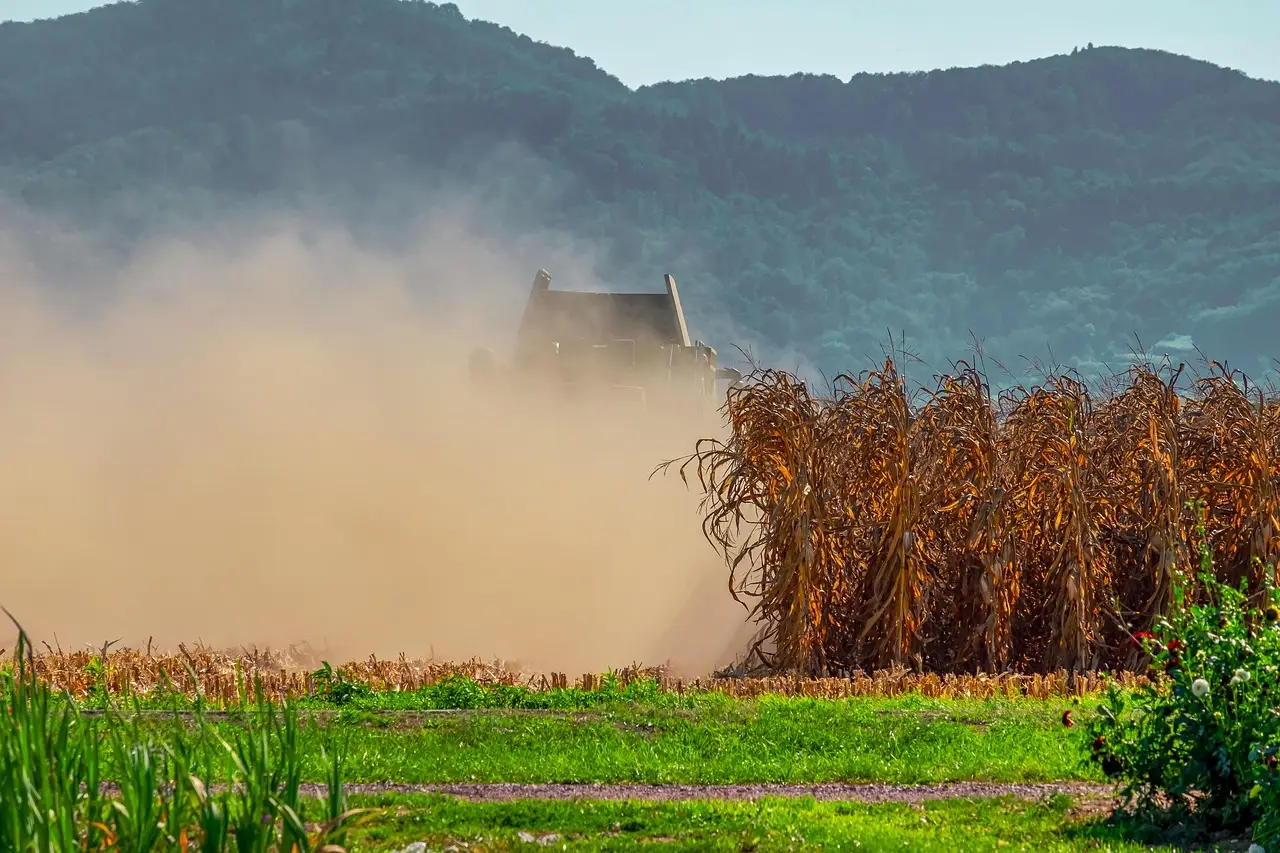
"In over 50 years, I've never seen the combines so dirty after working the fields," Greving said. "Normally, we would change the engine air filter once or twice per harvest, but this year, we've been changing it two or three times a day."
How far along is harvest?
On Oct. 19, USDA's National Agricultural Statistics Service reported the Nebraska corn harvest at 37% complete, up 10 points from the previous week. The five-year average for that date is 48%. Harvest pace, in short, trails the norm even as the yield projection has climbed.
Is tar spot the whole story?
Brandon Christiansen of Plainview expected tar spot early, as it arrived in 2024. "This year it came on later, and then at the end of the season, it just blew up," he said.
But Nebraska Extension plant pathologist Tamra Jackson-Ziems, who scouted fields across the state through the summer for ScoutNebraska, a new weekly live in-field scouting platform for farmers, crop consultants and ag professionals, cautions against a single-cause diagnosis. She cited field-to-field variation, southern rust, intense early-summer heat and warm night temperatures, followed by weeks of heavy cloud cover and high relative humidity.
"While farmers may be alarmed at the amount of gray to black fungi on corn leaves, some of that is disease pressure, but also the beneficial fungi breaking down the residue," she said. "So, yield differences may be attributed to a combination of factors."
Her scouting turned up further problems: corn kernels germinating inside the husk where moisture collected, ear rot, stalk rot and crown rot. Compromised stalks shut plants down early and cannot withstand wind without lodging. Her advice is direct. Farmers should prioritize harvesting earlier those fields where standability might be an issue.
Where is tar spot heading?
For the first time, Jackson-Ziems observed tar spot in southwest Nebraska, a region where arid weather had kept it off farmers' radar. She expects the disease to persist and expand west and north across the state, having already moved from eastern Corn Belt states into Nebraska. "It is probably only a matter of time when it will be confirmed in eastern Colorado, too," she said.
What did fungicides deliver?
Christiansen applied fungicide twice this season, slightly later than in 2025, using the most expensive products on the market. On his irrigated corn, treated fields out-yielded check strips, but not by much.
"High-yield farmers in the East are applying fungicide several times during the growing season, and that is our future," he said. "But if that's the case, we don't need to use the most expensive fungicide on the market. We can get by with less expensive options."
Fungicide timing, method and coverage made a difference this year, according to Jackson-Ziems. Genetics did too. Christiansen said farmers in the East, who have managed this disease longer, show which hybrids stand up better.
What should farmers watch?
Christiansen's late-season winds leaned his best-yielding corn while poorer corn stood. He has ordered pickup attachments for his corn header, and Greving called pickup reels a necessary tool this year. Leaning popcorn fields are under quality scrutiny after rapid maturation and fast drydown.
Christiansen points to fundamentals: uneven emergence limited the crop from the start, an early drought gave way to a sopping month, and irrigation pivots keep fields wet around the clock, creating the environment for disease. "We are going to have disease," he said. His prescription is soil fertility, season-long crop health, the right genetics and a hard look at return on investment for every input.
He expects corn genetics research to eventually catch up with tar spot, just as it did with gray leaf spot. But he warns that new diseases and insects, unforeseen now, will cause just as much trouble down the road.
via Farm Progress (Source)
More from Olivia Hart
Show full bio
News editor covering regulation, policy and their impact on production farming and field operations at Arable Wire.
187 articles
Nearby records
- YL 32US corn harvest tops 17.6 t/ha as weather disrupts seasonOctober 11, 2026
- LM 87USDA's 181.2 bpa corn yield meets farmer skepticism in Corn Belt surveyOctober 28, 2026
- EC 39NASS corrects September corn yields: Kansas down 3, Nebraska up 5October 26, 2026
- VU 83Kansas Wheat Harvest Opens With Yields Near 60 Bushels Per AcreOctober 3, 2026
- JJ 37Soybeans Done, Corn at 200–250 bu/ac: Iowa Harvest RollsOctober 19, 2026