Precision Spraying Cuts Herbicide Costs by $20 per Acre
A US farmer reports $20 per acre in herbicide savings from precision spraying — a benchmark that implies four-to-fivefold returns on subscription costs for row-crop operations.
- Entered
- Plot
- 1.0 ha
- Record
- 409 words
- Walk-through
- 2 min
DrillSprayHarvestCurrent stage
Agronomist’s notes
- Farmer reports $20 per acre savings on herbicide costs from precision spraying (Farm Progress)
- On 2,000 acres, $20/acre equals roughly $40,000 in chemical savings per season
- Savings depend heavily on weed pressure: light-pressure fields see the largest percentage reductions in chemical volume
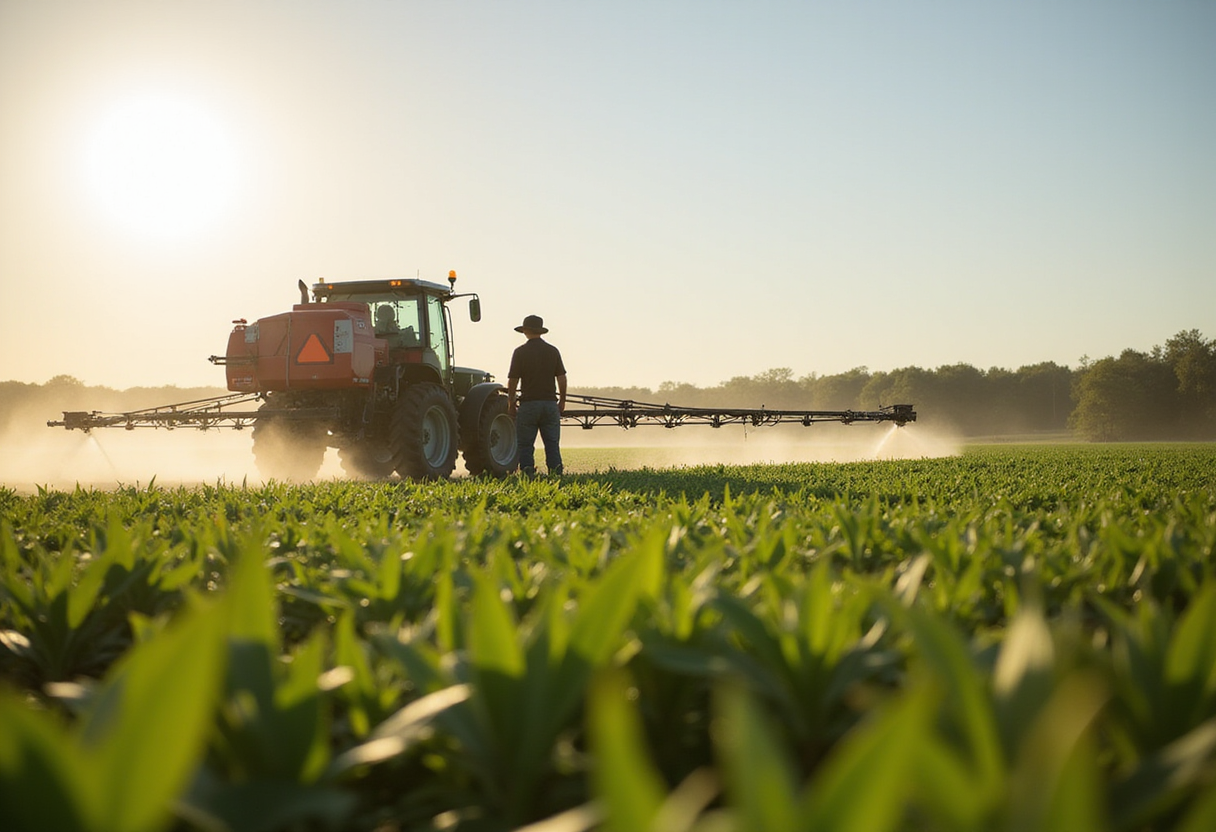
A US farmer reports saving $20 per acre on herbicide costs after switching to precision spraying technology, according to Farm Progress.
The figure is significant for row-crop operations. On a 2,000-acre corn and soybean farm, $20 per acre translates to $40,000 in chemical savings in a single season — before accounting for any yield protection benefits from more timely weed control. Even at half that scale, the saving would cover a substantial share of the subscription or hardware costs that target-selection spray systems typically carry.
Precision spraying systems work by distinguishing crops from weeds in real time, using camera arrays and machine-vision algorithms, then firing individual nozzles only where a target is detected. The approach matters most in row crops with high seed populations, where blanket spraying puts most of the chemical on bare ground or crop leaf area rather than on weeds. Targeted application can cut total herbicide volume dramatically on weedy acres while maintaining clean fields.
The economics shift depending on weed pressure. Fields with light pressure see the largest percentage reductions in chemical use, because most of the boom passes over ground with nothing to spray. Heavy-pressure fields save less per acre but benefit from the ability to apply higher rates precisely where they are needed, which can help manage herbicide-resistant weeds without broadcast-increasing rates across the whole field.
For growers weighing the investment, the $20-per-acre benchmark offers a concrete payback calculation. If a system costs, for example, $4 to $5 per acre annually on a subscription model, the reported saving implies a four-to-fivefold return on that line item alone. Growers should run the numbers against their own chemical bills from the past two or three seasons, broken out by field, before committing — weed pressure varies enough between farms that blanket averages from another operation may not transfer.
The saving also has an operational dimension. Less chemical per acre means fewer refill stops, lower water hauling, and reduced exposure risk during mixing. In tight planting and spray windows, those time savings can matter as much as the input cost reduction.
Farm Progress reports the figure as part of its coverage of adoption experiences with precision application on US farms. Growers interested in the technology should watch for full trial data and cost breakdowns as more operations publish multi-season results, and compare systems on recognition accuracy in their own crop types before signing on.
via Google News: spraying season farm (Source)
More from Tom Whitfield
Show full bio
Staff writer covering marketplaces and e-commerce at Arable Wire.
38 articles
Nearby records
- AU 80John Deere See & Spray Covers Five Million Acres in 2025October 3, 2026
- MU 27Weed pressure mounts in southern Minnesota as spray window closesOctober 3, 2026
- BY 18Saving Time and Maximizing Resources on Spray ApplicationsOctober 3, 2026
- UU 63John Deere Bets on AI to Drive 'Decision Agriculture' ShiftOctober 1, 2026
- BV 45Spray Drones Gain Ground in Crop ProtectionSeptember 29, 2026