Sun overexposure is a major safety risk for farm workers
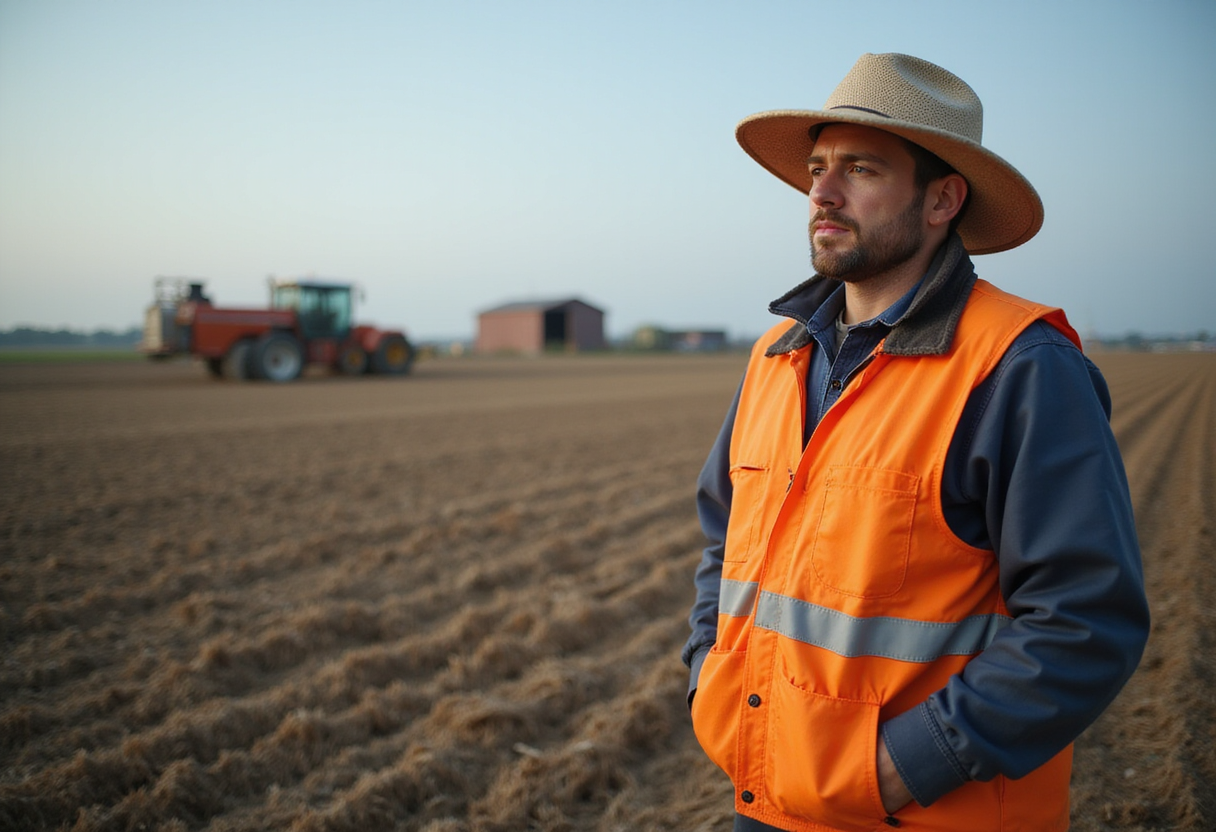
Sun overexposure is a major safety risk for farm workers, building invisibly across seasons of midday fieldwork and demanding managed scheduling, shade and protection.
- Entered
- Plot
- 1.6 ha
- Record
- 642 words
- Walk-through
- 3 min
DrillSprayHarvestCurrent stage
Agronomist’s notes
- Sun overexposure is identified as a major safety risk for farm workers.
- Fieldwork concentrates in months and hours of peak UV radiation, driving cumulative exposure.
- Prevention relies on scheduling tasks away from midday, shade, protective clothing, sunscreen and accessible water.
Sun overexposure can be a major safety risk for farm workers, and it is one that farm businesses routinely underestimate next to the more visible hazards of machinery, livestock and chemicals.
The risk is structural, not incidental. Fieldwork concentrates during the months and hours of peak ultraviolet radiation. Harvest, spraying, cultivations and stock handling all push staff into open ground through the middle of the day, when UV levels are at their highest. A worker who spends full shifts outdoors across a season accumulates exposure that office-based safety frameworks were never designed to capture.
The consequences show up in two timeframes. In the short term, sunburn, heat stress and dehydration degrade concentration — and degraded concentration around a running baler, a telehandler or a stock corral is itself a safety hazard. In the long term, cumulative UV exposure is an established driver of skin damage and skin cancer risk. Outdoor workers carry that risk year after year, often without any formal monitoring.
That persistence is what distinguishes sun exposure from most other farm hazards. A guard failure is visible and gets fixed. UV damage is invisible at the time of exposure, builds silently, and only presents as a medical problem years later. Because the harm is deferred, it rarely triggers the immediate corrective action that follows a near-miss with machinery.
There is also a cultural dimension. Heat and bright sun are treated as normal conditions of the job rather than as hazards to be managed. Workers may skip protective clothing because it is uncomfortable during physical labour, postpone breaks to keep a task moving, or ignore early symptoms of heat stress — thirst, headache, dizziness — until they become incapacitating. On busy farms with lean crews, the pressure to keep working through the hottest part of the day is real.
Managing the risk does not require expensive infrastructure. It requires the same disciplined approach farms already apply to machinery guarding and chemical handling.
Shade and scheduling come first. Where possible, high-exposure tasks should shift to early morning and late afternoon, leaving shaded or indoor work for the midday window. Even a partial rearrangement of the day's task order cuts peak-hour exposure meaningfully. Break areas should offer real shade, not just a parked trailer.
Personal protection comes second. Wide-brimmed hats, long-sleeved lightweight clothing, and sunscreen on exposed skin form the baseline. Sunscreen only works if it is actually available at the point of work — stocked in the cab, the farm shop and the field kit — and if workers are given the time to reapply it through the day. A single morning application does not survive a full shift of sweating work.
Hydration is the third leg. Water needs to be accessible in the field, not only back at the yard, and drinking should be routine rather than reactive. Supervisors should treat a worker who has stopped sweating, becomes confused or staggers as a medical emergency, not a sign of weakness.
Responsibility sits with management. A safety policy that never mentions UV exposure sends a message about what the business takes seriously. Briefing seasonal and casual staff matters especially: they are often the least familiar with the farm's routines and the least likely to speak up when they are struggling. Recording sun-related incidents, including minor sunburn and heat exhaustion, builds the picture needed to justify scheduling changes.
The economics argue for action as much as the duty of care does. A crew member incapacitated by heat during harvest, or lost to long-term illness, costs the business at exactly the moment labour is scarcest and most valuable. Prevention through scheduling, clothing and water is cheap against that.
Farmers should treat the approaching high-UV season as a prompt to review task scheduling, restock protective supplies and brief all staff — permanent and seasonal — before the busiest fieldwork weeks arrive.
via Google News: farm safety workers (Source)
More from Tom Whitfield
Show full bio
Staff writer covering marketplaces and e-commerce at Arable Wire.
38 articles
Nearby records
- XE 80Farmers urged to put safety first as sector holds poorest safety recordSeptember 29, 2026
- GM 52National Farm Safety Week Calls for Better Work PracticesOctober 1, 2026
- KA 31417 Deaths: NIOSH Marks Farm Safety Week as Harvest Danger PeaksSeptember 29, 2026
- KW 36Extreme heat forces specialty crop farmers to rethink harvest timingOctober 3, 2026
- LH 10Teenage farm worker died after becoming trapped in bale wrapperSeptember 29, 2026