The Mill opens Maryland's first new dry mix fertilizer plant in 15 years
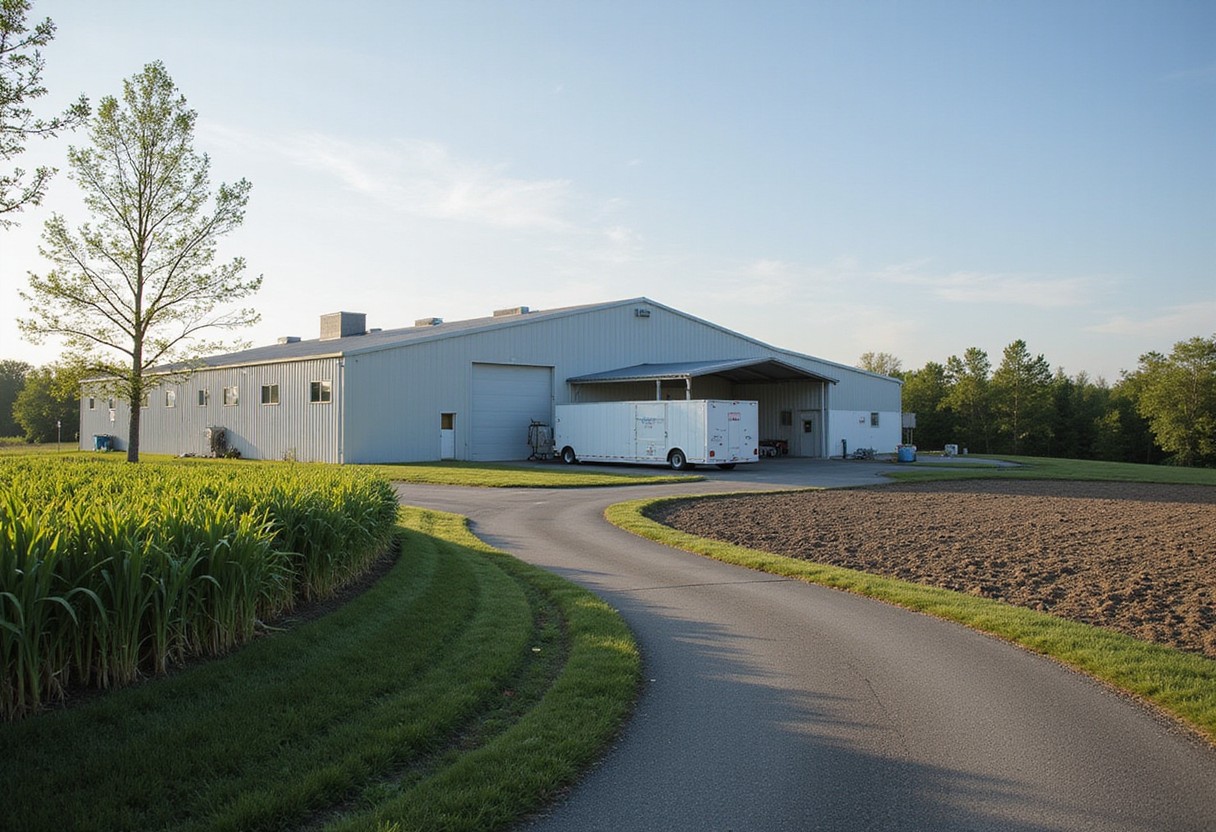
The Mill in White Hall, Maryland has opened a 12,000-square-foot dry mix fertilizer plant — the state's first new build of its kind in 15 years, doubling storage to 2,000 tons and tripling loading to 70-100 tons per hour.
- Entered
- Plot
- 2.2 ha
- Record
- 877 words
- Walk-through
- 4 min
DrillSprayHarvestCurrent stage
Agronomist’s notes
- The Mill's 12,000 sq ft facility stores 2,000 tons and loads 70-100 tons an hour — roughly triple the previous rate
- Construction started August 2025; weather delays pushed opening from spring 2026 to autumn 2025
- The project received a $1 million cost-share grant from Maryland's Build Our Future Pilot Program
- Sulfur prices have climbed past $1,000 against a 10-year average of $170, per The Mosaic Co.
- KeyState Nitrogen's $2 billion Pennsylvania plant could offset 60% of mid-Atlantic and Northeast nitrogen imports when it opens in 2030 or 2031
The Mill in White Hall, Maryland opened a 12,000-square-foot dry mix fertilizer facility this autumn, the first new build of its kind in the state in more than 15 years.
The prefabricated metal building with a fabric roof holds 2,000 tons of product — double the old site's capacity. A computer-controlled Doyle AutoBatch mixer pulls and blends fertilizers automatically, cutting the manual grind that once defined peak season at the 50-year-old mill.
Mark Holloway, agronomy operations manager at The Mill, said the upgrade could push outbound loading to between 70 and 100 tons an hour, roughly triple the previous rate.
"We almost prayed for a rainy day during the week, so we could have a whole day where we unload trucks," Holloway said, describing the spring crunch at the old site. "Farmers today require speed, accuracy and timeliness, and we couldn't really do all three as well as being able to offer the newest products in the old place. This facility will do that."
Construction started in August 2025. Weather delays pushed the opening from spring 2026 to this fall. The project drew a $1 million cost-share grant from Maryland's Build Our Future Grant Pilot Program and Fund.
What is the facility storing?
The building contains several bays for potash, MAP, urea and AMS, plus at least two spare bins reserved for products now in trial. A heated floor cuts waste and keeps the working area cleaner.
Ben Hushon, crop adviser and partner at The Mill, said every tonne of urea leaves the dock stabilized, and 100% of the phosphate carries a polymer coating to keep it plant-available.
"I think part of the reason Maryland accepted us for this cost-share grant was the fact that 100% of our urea is stabilized coming off the truck, and 100% of our phosphate is also protected with a polymer coating to help keep it available for the plant," Hushon said. "But we're keeping at least one bin spare for a potential new product that we were running some trials on this year at the showcase to see if it's real."
Why are fertilizer prices still high?
Capacity gains do not insulate growers from stubborn nutrient prices. Josh Linville, vice president of fertilizer at StoneX Financial Services, said nitrogen, phosphate and potash all skipped their typical summer resets.
"Nitrogen typically sets its low-water market in the summer. Phosphate typically has a 'reset' in summer but didn't at all this year. Potash typically has a 'reset' in summer but didn't at all this year. So, everything remains high," Linville said.
The drivers are geopolitical. Russian export flows face disruption from infrastructure attacks. Shipments through the Strait of Hormuz remain unreliable. European nitrogen producers continue to struggle under high gas costs. Sulfur, the feedstock for MAP and DAP, has climbed past $1,000 — roughly six times its 10-year average of $170, according to Sarah Fedorchuk, vice president of government and public affairs with The Mosaic Co.
When will domestic supply ease the squeeze?
Two large U.S. projects could eventually rebalance regional supply, but neither has broken ground.
KeyState Nitrogen, based in Pennsylvania, is on track to open a $2 billion nitrogen plant in Karthaus Township, Clearfield County, producing 1 million tons of granular urea and UAN a year plus 8 million gallons of diesel exhaust fluid. Industry reports say the site could offset 60% of nitrogen fertilizer imports into the mid-Atlantic and Northeast when it starts up in 2030 or 2031.
Michigan Potash & Salt Co. secured an $80 million USDA grant last year for a $1.2 billion potash operation in northern Lower Michigan. The mine is designed to produce upward of 800,000 tons of potash and 1 million tons of food-grade salt annually — billed as the largest U.S. source of the mineral.
What can farmers do before that relief arrives?
Eric Rosenbaum, an agronomist with Rosetree Consulting, recommends a postharvest soil test as the first step, particularly on fields untested for two or more years. He then layers in zone mapping and removal-based scripts.
"Let's say you go out and soil-tested last fall, November of 2025. Maybe you made a fertilizer recommendation based on that to project where 2026 was likely going to be," Rosenbaum said. "Now you can go back to 2025, and you can overlay 2026 yield data and get really accurate fertilizer recommendations for next year. It's slowly catching on."
Hushon agrees that precision matters as much as supply. "We've got to be protecting the nitrogen and the phosphorus we're putting out. Number one, to keep it out of the water, but number two, to protect the farmer's pocket," he said. "Just because we have a source, we still, again, need to be thinking about how we protect that and make sure the farmer gets as much of that that he puts out as he can."
Mid-Atlantic growers should watch The Mill's spare-bin trials this winter and any 2026 release dates from KeyState Nitrogen and Michigan Potash & Salt, both of which will set the tone for nitrogen and potash pricing through the rest of the decade.
via eu-images.contentstack.com (Original)
More from James Calloway
Show full bio
Correspondent covering marketplaces and e-commerce at Arable Wire.
113 articles
Nearby records
- VU 83Kansas Wheat Harvest Opens With Yields Near 60 Bushels Per AcreOctober 3, 2026
- EM 59Kansas Wheat Harvest Day 8: Yields Hold Steady as Cutting Reaches Central FieldsOctober 3, 2026
- RF 512026 HRW Wheat Harvest Nears Finish as Spring Crops Move AheadOctober 10, 2026
- GP 19More Than 25 Machinery Debuts Light Up 2026 Winter Trade Show CircuitOctober 10, 2026
- TV 30Harvest Progress Climbed Sharply Last Week, farmnewsNOW ReportsOctober 10, 2026