Beavers, lagoons and soya: UK farmers rewrite drought playbooks
Britain's earliest cereals harvest in 20 years is pushing farmers toward beaver dams, 4m-litre lagoons, legumes and strip tillage as drought adaptation accelerates.
- Entered
- Plot
- 2.6 ha
- Record
- 1,025 words
- Walk-through
- 5 min
DrillSprayHarvestCurrent stage
Agronomist’s notes
- The AHDB reports the earliest UK cereals harvest in at least 20 years after this summer's heatwaves and drought.
- West Pikefish Farm in Kent is building a 4m-litre winter lagoon fed by wetland features, with partners including the South East Rivers Trust, Wrap and the Environment Agency.
- Enclosed beavers on Chris Jones's Cornwall beef farm have built a reservoir holding 3m litres of water over nine years.
Britain has just recorded its earliest cereals harvest in at least 20 years, according to the Agriculture and Horticulture Development Board, and the push to adapt is now reshaping decisions on farms from Cornwall to Cumbria.
The hot, dry summer has left cauliflowers "suntanned" with yellow curds instead of white, cucumbers misshapen and broccoli undersized, forcing the UK to import more vegetables than usual. Reservoirs remain the default answer for many growers, but they are costly, need planning permission and often cannot carry a farm through long dry spells. That gap is driving a wave of more inventive tactics.
Soil, hedges and smarter flows
In south Cambridgeshire, Martin Lines has already finished harvest a month earlier than usual after his second consecutive hot, dry and windy summer. "There's like a hot hairdryer on everything, and it just saps the moisture out," says Lines, an arable farmer who leads the Nature Friendly Farming Network.
His approach starts below ground. "We're focused on the soil, we're focusing on having bigger, bushier hedges and more trees in the landscape to slow the flow of air down," he says. Healthier soils hold more water; shelterbelts cut the drying wind.
Lines wants farmers to audit their annual water needs against what rainfall they can capture, using rainwater harvesting tanks connected to gutters on farm buildings. He also sees an untapped opportunity in river management. "What we need to do is connect up to local drainage and rivers. Most rivers have digital flow sensors now, so the moment there is excess flow that is going to go out to sea, farmers should be messaged to say 'turn your pump on'. We could manage this flow a lot smarter than we are now."
A 4m-litre lagoon on old orchard land
In Kent, West Pikefish Farm, run by the Smith family near the River Teise outside Maidstone, is converting an old orchard — grubbed up because it regularly flooded — into ponds, scrapes and wetland features that fill in winter and feed a larger winter lagoon. The land can still be grazed and could return to traditional orchard use.
The lagoon will store 4m litres of silt-filtered water for summer irrigation. "It's about risk management," says farmer James Smith, who is increasingly worried about abstraction from the Teise during droughts. The scheme also buffers floods: "When it is winter and the river is in spate it has a bellows effect and the river can flow into these features and reduce risk downstream."
Smith argues the model is scalable. "We are proposing these features could be rolled out all along the catchment, at landscape scale, making it more resilient, holding water in the landscape rather than sending it down as quick as we can to the nearest village."
Delivery, though, is slow. The project — run with partners including the South East Rivers Trust, the waste reduction body Wrap and the Environment Agency — had been due to break ground this summer but planning consents and surveys have pushed it to next year. "We are trying to create a roadmap so hopefully it can become more streamlined," Smith says.
Swapping crops for a hotter climate
Lines is "now looking at what Europe is growing like sunflowers and soya beans". Legumes — beans, peas, chickpeas and lentils — suit hot, dry conditions and could strengthen UK food security, though Britain's volatility punishes experimentation. "We tried sunflowers a couple of years ago and that was the wettest winter and spring. It's the unpredictability that is really challenging, we don't actually know how the next season is going to be," he says.
Prof Pete Iannetta of the James Hutton Institute points out that legumes occupy just 5% of UK cropped land. "In northern Germany they are growing tropical legumes, things like cowpeas [such as black-eyed peas] and soya beans. These were not traditionally associated with northern Europe and would come from India and Myanmar. Crops such as chickpeas are becoming more viable, we have even got some in the south of England and the quality will improve over time."
Beavers as water engineers
Chris Jones's beef farm in Cornwall has had almost no rain since the beginning of June, yet his cattle are still grazing without supplementary feed. He has planted trees to retain water and shelter livestock, and runs rotational grazing, moving the herd between small paddocks so it returns to each spot only every three to six months.
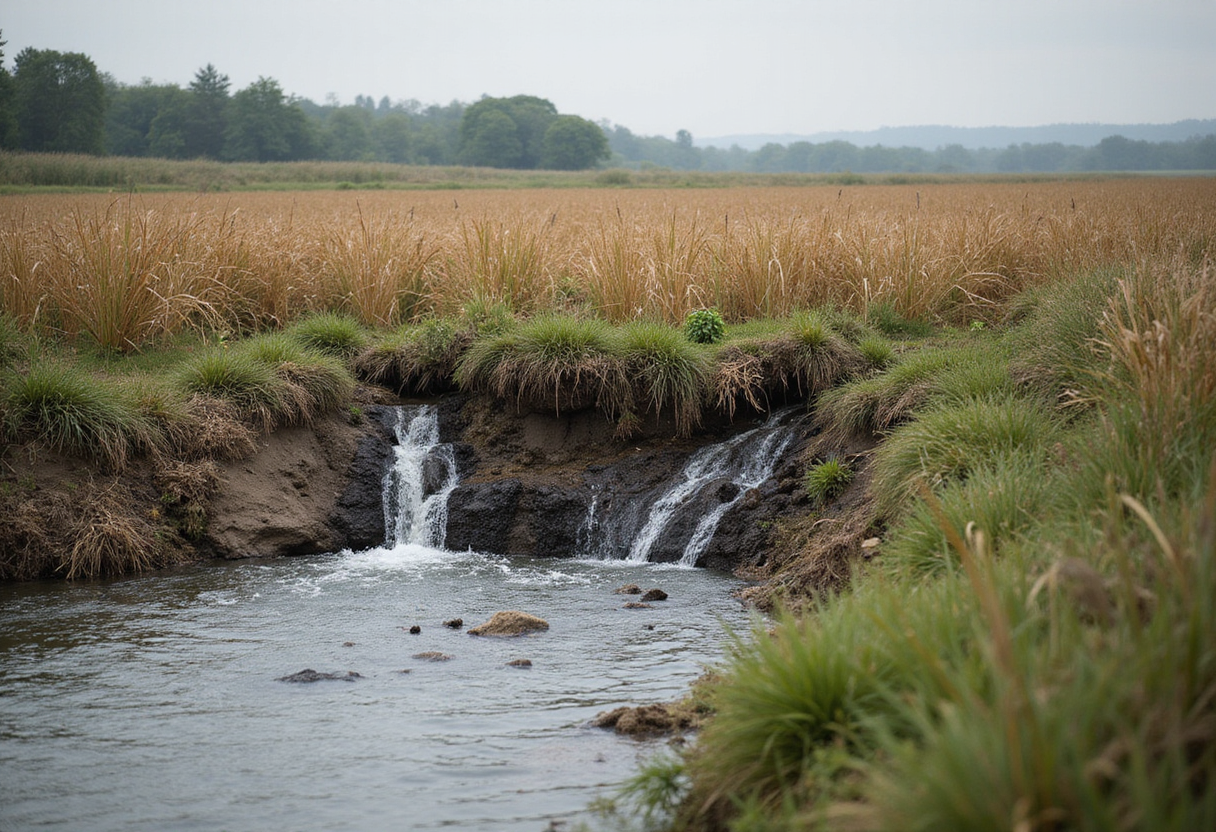
His best asset is a family of beavers, enclosed since their introduction nine years ago, whose dams have created a reservoir holding 3m litres. The structures slow flood flows, preserve damp grazing areas and can be pumped when needed — as they were in 2022, when many farms ran dry. "We haven't yet had to pump out but we may well have to," Jones says this year.
Beavers are "the most useful and cheapest way to build reserves of water on our land", he says, working "with minimal financial and environmental cost". His verdict on the climate: "Since last year we stopped being green and occasionally hot and dry Britain and joined the Mediterranean. The race is on now to adapt."
Gutters, strip tillage and drone shading
Katie Cross, a water specialist at Wrap, says farmers need a "combination of tools", from nature-based tactics to water collection. In Cumbria, nine cattle farmers are adding extra guttering and large water butts to store winter rainfall from building roofs for dry spells. Norfolk growers are trialling strip tillage — leaving unploughed strips between maize or sugar beet rows to hold soil moisture and cut irrigation needs — while cover cropping between seasons is already widely used to retain moisture and prevent run-off.
Shading is another lever: trees, or "dusting" polytunnel roofs with specialist shading substances applied by drone, can cut irrigation demand. In France and the US, some farmers are going further, mounting solar panels above crops to shade them while generating energy.
Farmers should watch Kent next year, when the Pikefish lagoon finally breaks ground — and its roadmap, if streamlined, could offer a template for catchment-scale water storage across the south east.
via theguardian.com (Original)
More from Olivia Hart
Nearby records
- LB 11Yorkshire Farmers Explain How They Keep Working in Extreme WeatherSeptember 29, 2026
- FU 49Kent pumpkin farms scrap pick-your-own after dry spring cuts crop to a tenthOctober 3, 2026
- BW 40Wheat Harvest Gains Momentum Across RegionSeptember 29, 2026
- RK 67U.S. Winter Wheat Harvest Outpaces Average PaceOctober 3, 2026
- DE 66Darlington farmer cannot sow crops due to hot dry weatherOctober 3, 2026