Coloma Farms marks 100 years of potatoes on Wisconsin's Central Sands
Coloma Farms grows potatoes on 850 of 2,700 acres in Wisconsin's Central Sands, marking 100 years and four generations of Diercks family production and leadership.
- Entered
- Plot
- 2.0 ha
- Record
- 793 words
- Walk-through
- 4 min
DrillSprayHarvestCurrent stage
Agronomist’s notes
- Coloma Farms plants about 850 of its 2,700 acres in potatoes each year in Wisconsin's Central Sands.
- Wisconsin produced 28.8 million cwt of potatoes on 68,000 acres in 2025, worth $466 million, ranking third nationally.
- 2026 yields averaged 300 cwt per acre for the early crop and 450-500 cwt for full-season potatoes.
- Four generations of the Diercks family have served as WPVGA president, starting with Ben Diercks in 1948-49.
- Irrigation pivots cover about 160 acres each, with one covering 200 acres.
Coloma Farms plants about 850 of its 2,700 contiguous acres in potatoes every year, and in 2026 the Wisconsin operation marked nearly a century of continuous family production. Steve Diercks, 78, and his son Andy, 55, run the farm four miles west of Coloma in Waushara and Adams counties, in the heart of the Central Sands, where every crop requires irrigation.
The Diercks family began growing fresh and seed potatoes in Langlade County in the 1930s. In 1962 the operation split, and Robert and his son Steve started the Coloma farm. Seed potatoes for Coloma were still grown in Langlade County.
"My dad had a good friend who was superintendent of the Hancock research station," Steve said. "They decided to come down this way because they could get the potato crop in 30 days ahead of the crop in Langlade County."
Potatoes follow a three-year rotation with corn, soybeans and canning crops. Coloma Farms also grows "little potatoes" for The Little Potato Co. of DeForest, Wisconsin, which required retrofitting equipment to handle the smaller tubers. Russet, red, white and yellow are the primary varieties, moving to market as chips, small bags and large crates.
How does the farm sell and store its crop?
A potato broker handles most sales, but the farm fresh-packs some potatoes in its own shed for direct delivery to grocery stores. The on-farm packing shed can store potatoes for nearly a year, giving grocers a consistent 12-month supply.
The farm employs nine people year-round and doubles that number during packing season. The Dierckses hire a trucking firm to haul most potatoes; buyers of fresh potatoes send their own trucks. "We don't want to be in the trucking business," Steve said.
Drainage drives everything on the sandy soils. "Potatoes don't like to have wet feet," Steve said. "If it rains a lot and the soil is wet for a long time, it can cause a problem with the crop."
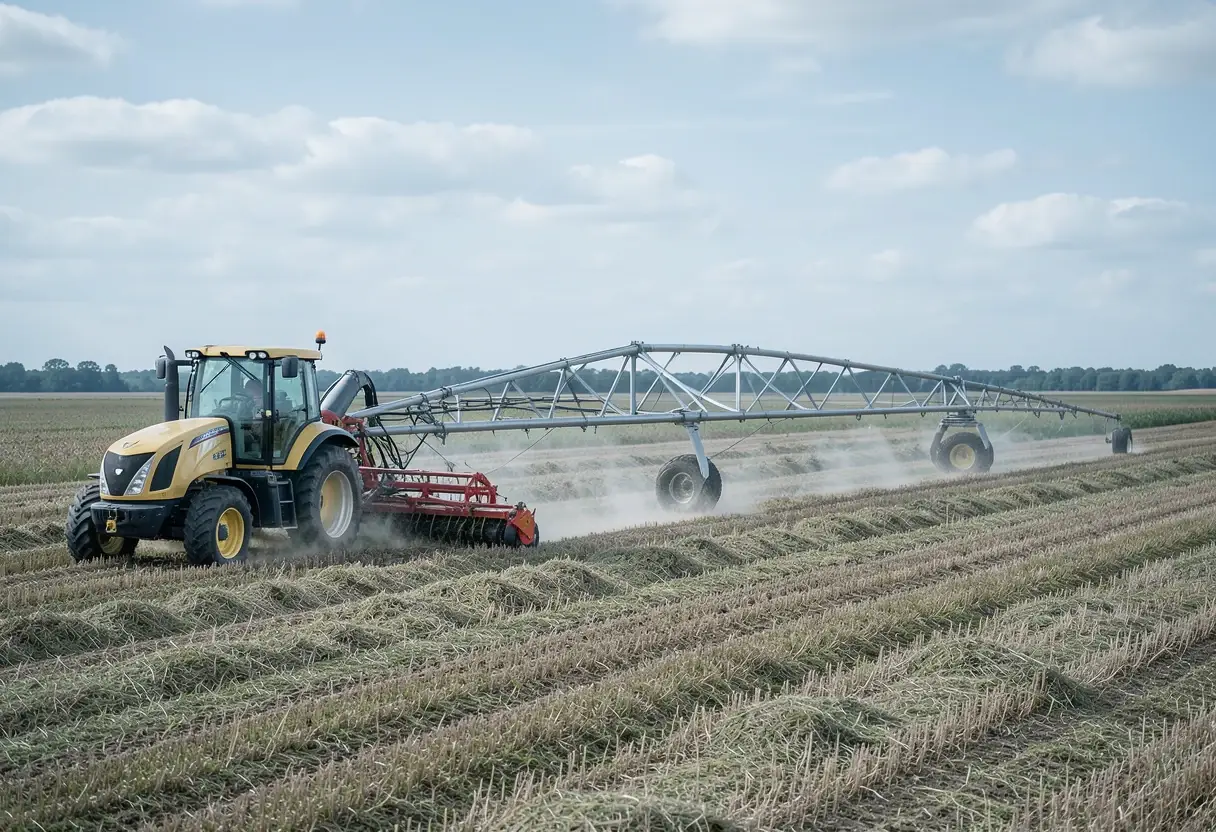
Irrigation pivots generally cover about 160 acres each, with one covering 200 acres. Water applications track rainfall and recharge. "Water quality is a bigger problem than water quantity," Steve said. "Ten years ago, everyone was worried about whether the wells were going to go dry, but the water table here hasn't changed. It's not like Nebraska and Colorado where it keeps falling. We measure our wells to see how they're doing."
What does the research partnership deliver?
Coloma Farms works with University of Wisconsin-Madison researchers on water efficiency across the whole operation, hosts field trials and maintains a UW observation facility on the property. "No one else in the country has the potato research team that we have here in Wisconsin," Andy said.
Planting starts around April 10, weather permitting, with most potatoes in the ground by the first week of May. The little potatoes, with a shorter season, go in later. Harvest runs from early August to early October — a window Andy said has lengthened because climate change delays the onset of cold weather. A windrower digs potatoes ahead of the harvester, and on a good day the farm covers about 40 acres.
Drones now spray chemicals on some fields, and packing equipment has become far more automated. Harvesting machinery has barely changed. "Our harvesting equipment is much the same as it has been," Steve said.
Steve handed the presidency to Andy several years ago and now serves as vice president. "I'll probably keep doing this until they kick me out," he said. "There are some things you like about a job, and now I get to do those things."
What did 2026 deliver?
Yields this year ran about average: 300 cwt per acre for the early crop and 450 to 500 cwt per acre for full-season potatoes. The 2026 price improved on 2025, though Andy called the 2025 price "terrible."
National Agricultural Statistics Service figures show Wisconsin growers produced 28.8 million cwt of potatoes on 68,000 acres in 2025, ranking third nationally behind Idaho and Washington. The 2025 Wisconsin crop was valued at $466 million.
The family's leadership record spans four generations. Ben Diercks served as the first president of the Wisconsin Potato and Vegetable Growers Association in 1948-49. Robert followed in 1975-76, Steve in 1989, and Andy's election in 2002 made him the fourth generation in the role. Andy now represents District 2 on the Wisconsin Potato Industry Board and spent 13 years on the state DATCP board, several as chairman. Steve sits on the state's Groundwater Coordinating Council.
Watch for the UW water-efficiency trials at Coloma Farms as the next stage of a partnership that has already shaped how Central Sands growers measure their wells.
via Farm Progress (Source)
More from Tom Whitfield
Show full bio
Staff writer covering regulation, policy and their impact on production farming and field operations at Arable Wire.
177 articles
Nearby records
- EG 55Pumpkin Season Underway as Van Groningen & Sons Nears 100 YearsSeptember 30, 2026
- FA 74Scottish potato lifting outpaces cereal harvest as yields lagOctober 10, 2026
- WP 54Saskatchewan harvest hits 93% as early snow slows progressOctober 15, 2026
- EZ 54York County corn farm loses thousands to weather extremesSeptember 29, 2026
- TT 13Rutgers Hunterdon research farm gives county growers local crop and equipment dataOctober 14, 2026