How Double C Cattle Company is reclaiming 30,000 acres
The Coffey family uses prescribed fire, mechanical thinning, herbicide and 20 solar wells across 30,000 acres to replace eastern redcedar with grassland for cattle and wildlife.
- Entered
- Plot
- 2.0 ha
- Record
- 791 words
- Walk-through
- 4 min
DrillSprayHarvestPlanning window
Agronomist’s notes
- Double C Cattle Company’s ranch covers 30,000 acres in Oklahoma’s Arbuckle Mountains.
- Up to 70% of rain striking an eastern redcedar canopy can evaporate before reaching streams or aquifers.
- The Coffeys developed 20 solar wells and received USDA Farm Bill cost-share for other grassland conservation work.
- The Coffeys use a three-stage sequence: mechanical removal, prescribed fire and follow-up herbicide.
- Chuck and Ruth Coffey’s grandchildren are the sixth generation of ranchers in the family.
By Daniel Okafor
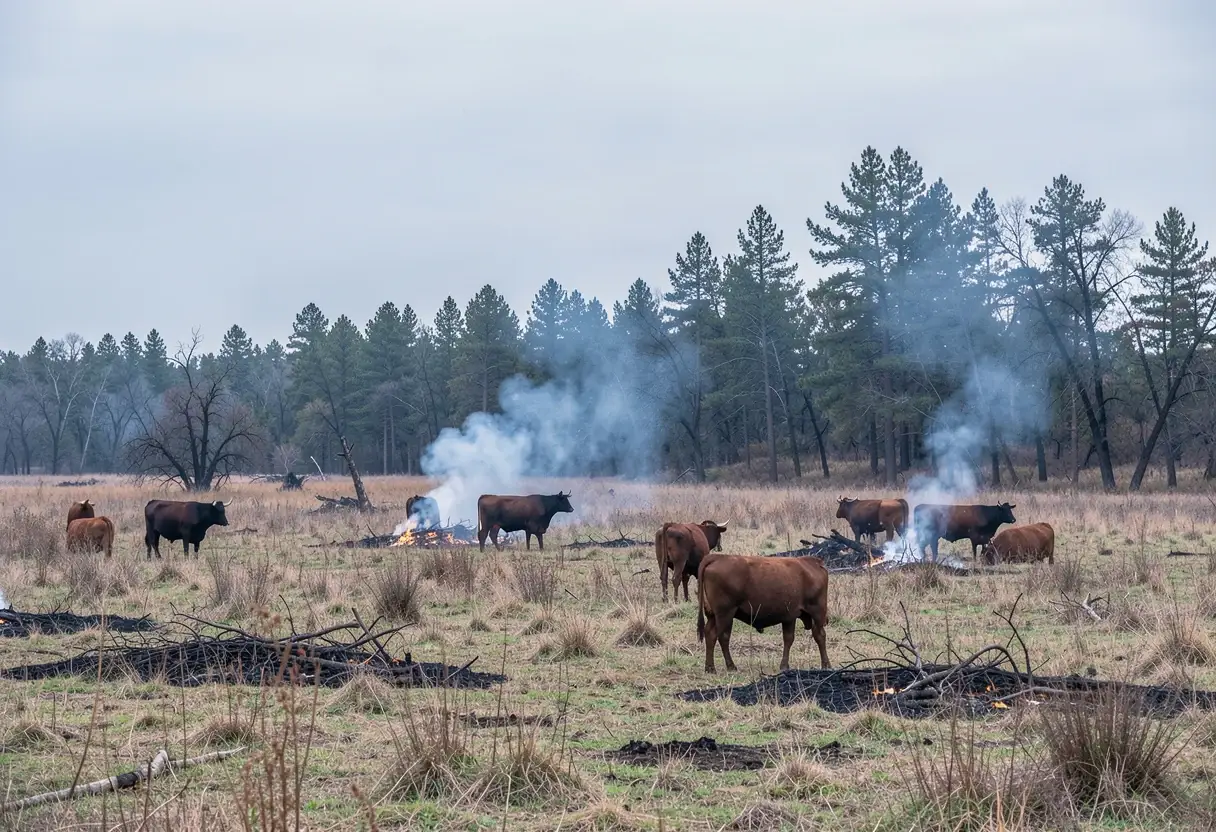
Double C Cattle Company’s award-winning 30,000-acre ranch in the Arbuckle Mountains of southern Oklahoma is using prescribed fire to remove eastern redcedar, recover forage and reduce wildfire risk across working prairie. The decision matters because dense brush cuts grazing capacity, intercepts rainfall and concentrates pests, turning land that should support perennial grass into scrub.
Chuck Coffey frames the operation’s priorities plainly: “It’s your plants that support everything, including the animals. Grass comes first, cows second.” That philosophy puts the range, rather than the herd, at the centre of production decisions.
Why is eastern redcedar such a costly problem?
The spread of eastern redcedar is the Coffeys’ biggest obstacle to growing grass and earning a profit. Eastern redcedar and ash juniper have overtaken much of America’s grassland over the past century because fire suppression allowed woody plants to expand.
Chuck says the Southern Great Plains should remain true prairie carrying big blue stem, little bluestem, Indian grass and switchgrass. He calls cedar a nuisance and a scourge because it overtakes land quickly and offers little value for livestock or wildlife.
Dense stands of cedar or juniper reduce available forage and crowd out native grasses and wildflowers. A dense redcedar stand acts like a roof over the range: its roots draw groundwater, while its leaves intercept rain. Up to 70% of raindrops that strike a cedar canopy can stay suspended and evaporate, never reaching streams or the aquifer.
The ecological cost includes pests. Seth Coffey says more cedar brings more ticks, horseflies and mosquitoes. While riding around the ranch, he noticed that he never sees a horsefly in the open range, another field indication that dense woody cover changes conditions at ground level.
Seth also points to the fallen-needle duff, the thick litter layer beneath cedar. Nothing grows under that layer, he says, and the material can burn for weeks without going out, worsening wildfire behaviour.
How does the Coffey treatment sequence work?
Chuck and Ruth Coffey, sons Seth and Aaron, and daughter Sarah have combined mechanical thinning, herbicide and prescribed fire to reclaim their prairie. Chuck and Seth are both trained ecologists, and their approach treats brush control as a repeated process rather than a one-off cleanup.
Their sequence has three stages:
- Mechanical removal: Bulldozers or chainsaws take out trees in heavily infested areas.
- Prescribed fire: Burns eliminate remaining brush and reinvigorate perennial plants, helping maintain grassland.
- Follow-up herbicide: Applications target seeds and seedlings that fire does not consume.
The three tools complement one another. Mechanical work clears the largest obstructions, fire reaches smaller woody growth, and herbicide closes the gaps left behind. Used together, they can reclaim prairie that fire alone will not keep clear.
Tanner Swank, grassland biome program manager for Pheasants Forever and the USDA Natural Resources Conservation Service (NRCS) Working Lands for Wildlife partnership, said: “The Coffeys are one of the culture drivers when it comes to prescribed burns. They’ve been fighting the good fight against woody plants for a long time.”
Swank’s assessment matters because it identifies the Coffeys as sustained practitioners, not operators making a single attempt at brush control. Their results depend on stacking tools and returning to surviving regrowth.
What do conservation payments add?
USDA Farm Bill conservation programs provided the family with cost-share for other grassland conservation work. The Coffeys also used innovative grazing strategies that foster healthy perennial grasses, linking the prescribed-fire programme to the condition and use of the forage it encourages.
They developed 20 solar wells, which improve water quality in streams and buffer the cattle herd during droughts. New wells and water tanks, funded in part by NRCS, help the family use the rangelands more effectively.
That support adds a water-management layer to the restoration effort. Removing trees addresses interception and forage competition, while the wells and tanks help maintain access to water and protect livestock through dry periods.
Can cattle and wildlife share the same prairie?
The benefits extend beyond cattle production. The ranch supports white-tailed deer, wild turkey, quail, jackrabbits, raptors, songbirds and roadrunner, Chuck’s favourite resident. His view is straightforward: habitat that works for wildlife also works for cattle.
The succession plan reaches beyond Chuck and Ruth. Their grandchildren represent the family’s sixth generation of ranchers, and the couple are teaching them to continue the stewardship tradition so they inherit healthy, productive grasslands rather than cedar forests.
For other Oklahoma ranchers, the next field decision comes after the flames cool: track surviving seedlings, treat them where fire has failed and remove trees that re-establish before dense stands re-form. On 30,000 acres, consistent follow-up will decide whether the Coffeys’ prairie recovery lasts.
via oklahomafarmreport.com (Source)
More from Daniel Okafor
Show full bio
Market editor covering money, funding and market shifts around production farming and field operations at Arable Wire.
198 articles
Nearby records
- UK 97Adding cattle can improve soil health, Farm Progress reportsSeptember 29, 2026
- WQ 67Stockpiled Bermuda Grass Saves Oklahoma Ranchers $1 Per Cow Per DayNovember 17, 2026
- FJ 8973% of Nebraska Pastures Poor as Heat Dome Presses U.S. Farm MarginsOctober 10, 2026
- SQ 42Oklahoma Corn Harvest Hits 67% as Pasture Conditions ImproveOctober 10, 2026
- SQ 15Winter Wheat Planting Advances as Pasture Conditions SlideOctober 14, 2026