Oklahoma wheat harvest 90% complete amid drought recovery and rain delays
Oklahoma's wheat harvest reached 90% completion, with drought-recovered fields meeting late-season rain. Test weight and elevator basis on the remaining ten percent will set the season's final grade.
- Entered
- Plot
- 1.7 ha
- Record
- 669 words
- Walk-through
- 3 min
DrillSprayHarvestCurrent stage
Agronomist’s notes
- Oklahoma wheat harvest is 90% complete, leaving roughly one in ten acres still to cut
- Season shaped by drought recovery at planting and late-season rain at harvest
- Remaining 10% of the crop carries disproportionate yield potential and quality exposure
- Test weight and protein readings on final loads will drive quality discount decisions
- USDA-NASS production estimate typically released in mid-July
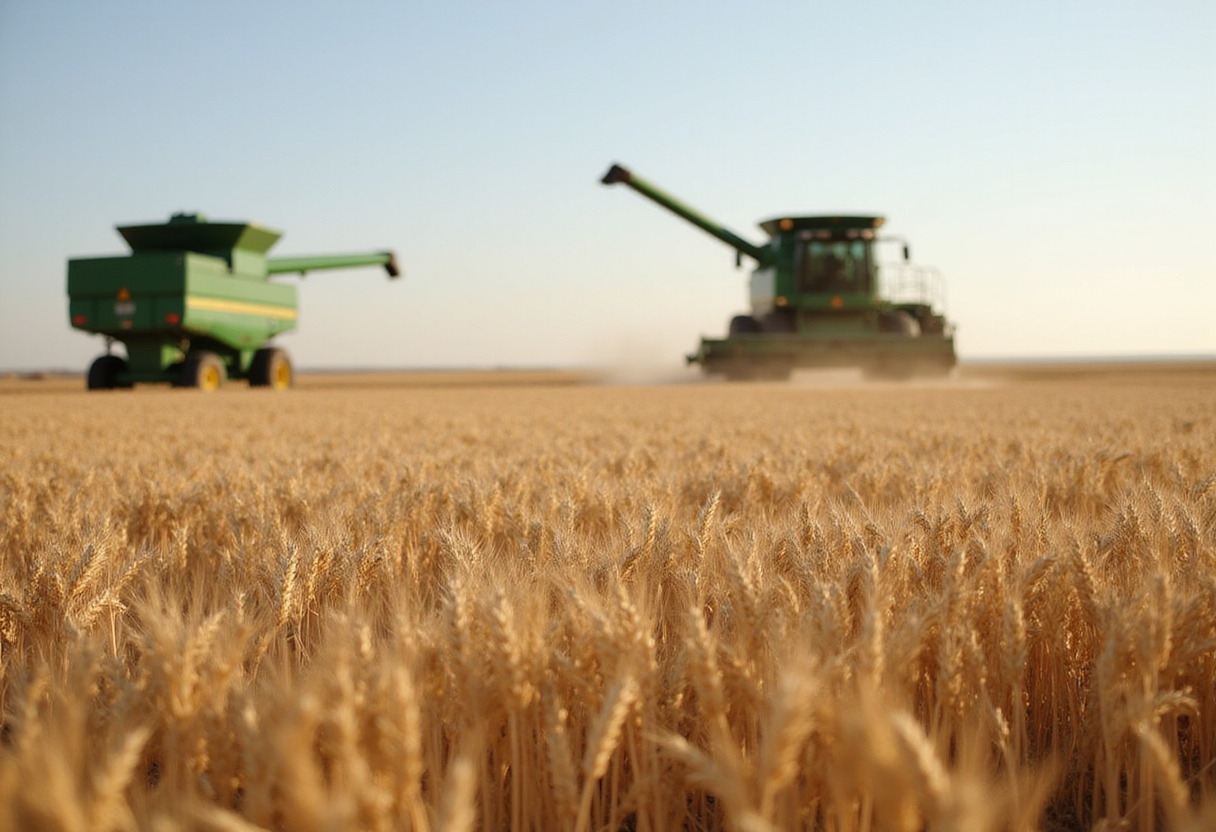
Oklahoma's wheat harvest crossed the 90% completion threshold in the latest reporting period, with combines still working roughly one in ten acres as the southern Plains run through the back end of the season.
The headline update from Oklahoma Farm Report frames the milestone under two competing weather narratives. Earlier drought conditions eased into enough moisture to establish a winter wheat crop. That same recovered moisture profile now complicates harvest, with late-season rain challenging the remaining acres still in the field.
The dual pressure is familiar to anyone who has cut wheat in a transitional climate: dry ground at planting followed by rain at the header. What makes the current Oklahoma window worth watching is timing. Most of the state's wheat has cleared before serious quality damage sets in. The remaining ten percent will determine whether the season ends near the five-year benchmark or with quality discounts dragging the state number below trendline.
What the drought recovery framing actually means
Drought recovery in the Oklahoma wheat context refers to soil moisture rebuilding after multiple dry years. That moisture was enough to establish a winter wheat stand without the failed-planting choices that defined worse seasons.
The headline framing is a positive signal for establishment:
- A crop that germinated on workable ground
- Tillered without heat-stress checkpoints cracking the stand
- Jointed with a rooting profile that could chase subsoil moisture through spring
For farmers outside the region, the takeaway is narrow but useful. A drought-recovered planting profile reduces one cluster of risks - thin stands, low plant populations, yield potential set at tillering. It does not insulate the crop from a different risk profile at harvest.
Why 90% is the dangerous point for rain
The last ten percent of a wheat crop typically carries a disproportionate share of the season's value. Operators cut the ripest, driest fields first to bank quality. The remaining acres are usually later-planted, later-maturing, or both, holding higher yield potential but also higher exposure to weather damage.
Rain in that window drives three distinct cost lines:
- Sprouted kernels that push grain from milling grade to feed grade
- Lodged stems that slow combine capacity and leave grain uncollected
- Elevated moisture that pulls loads into drying or applies shrink at the elevator
Each line reduces per-tonne return on exactly the acres operators most wanted to bring in clean.
For southern Plains farmers, this is a familiar late-season squeeze. Operators in Kansas, the Texas Panhandle, and northern Missouri face a similar calendar. They will read the final Oklahoma data as a proxy for their own harvest run-up and as a signal on local elevator basis in the weeks ahead.
What farmers should watch next
The remaining ten percent of the Oklahoma crop resolves into one of two outcomes over the next reporting cycle. Either the final acres come off clean and the season closes at or near the five-year benchmark, or rain damage forces quality discounts large enough to drag the average below trendline.
Two datasets will settle the question:
- The next Oklahoma Farm Report update, confirming whether the final acres made it into the bin without quality compromise
- The official USDA-NASS production estimate, landing in mid-July and incorporating any quality-driven revisions to harvested acreage
Producers still cutting in comparable climates should watch two reads as the combine moves into later-maturing fields. Test weight signals whether sprouting has set in or kernels are simply light from drought-stressed fill. Protein levels move either way on delayed harvest and determine which loads gain or lose in the elevator spread.
Discounts on sprouted or weathered wheat can swing per-tonne returns by enough to change the storage-versus-sell decision on borderline loads. Operators with bin space may find a hold-and-blend strategy pays better than selling into a discounted spot market. Those without storage will be watching basis bids daily for any narrowing of the discount before the combine rolls into the last fields.
via Google News: harvest report wheat (Source)
More from Priya Raman
Nearby records
- RZ 94Oklahoma winter wheat harvest hits 44% completeOctober 3, 2026
- TN 28Oklahoma wheat crop halved as drought grips 2026 seasonOctober 3, 2026
- AC 43Oklahoma wheat harvest nears finish with quality up, bushels downOctober 3, 2026
- WZ 75Oklahoma faces poor, early wheat harvest following warm winter - kgou.orgOctober 3, 2026
- AU 62Oklahoma Wheat: 2026 Harvest Nears With Disease Pressure RisingOctober 3, 2026