Two Decades of Conservation Agriculture Rebuilds Soil Structure, Report Finds
Twenty years of conservation agriculture rebuilt soil structure and doubled key soil outcomes, putting a number on a payoff that arrives on decadal, not seasonal, timescales.
- Entered
- Plot
- 1.1 ha
- Record
- 456 words
- Walk-through
- 2 min
DrillSprayHarvestCurrent stage
Agronomist’s notes
- Twenty years of continuous conservation agriculture doubled soil structure outcomes
- Improvement equates to roughly 3.5% compound gain per year over the period
- Long-term evidence covers four times the length of typical 3-5 year field trials
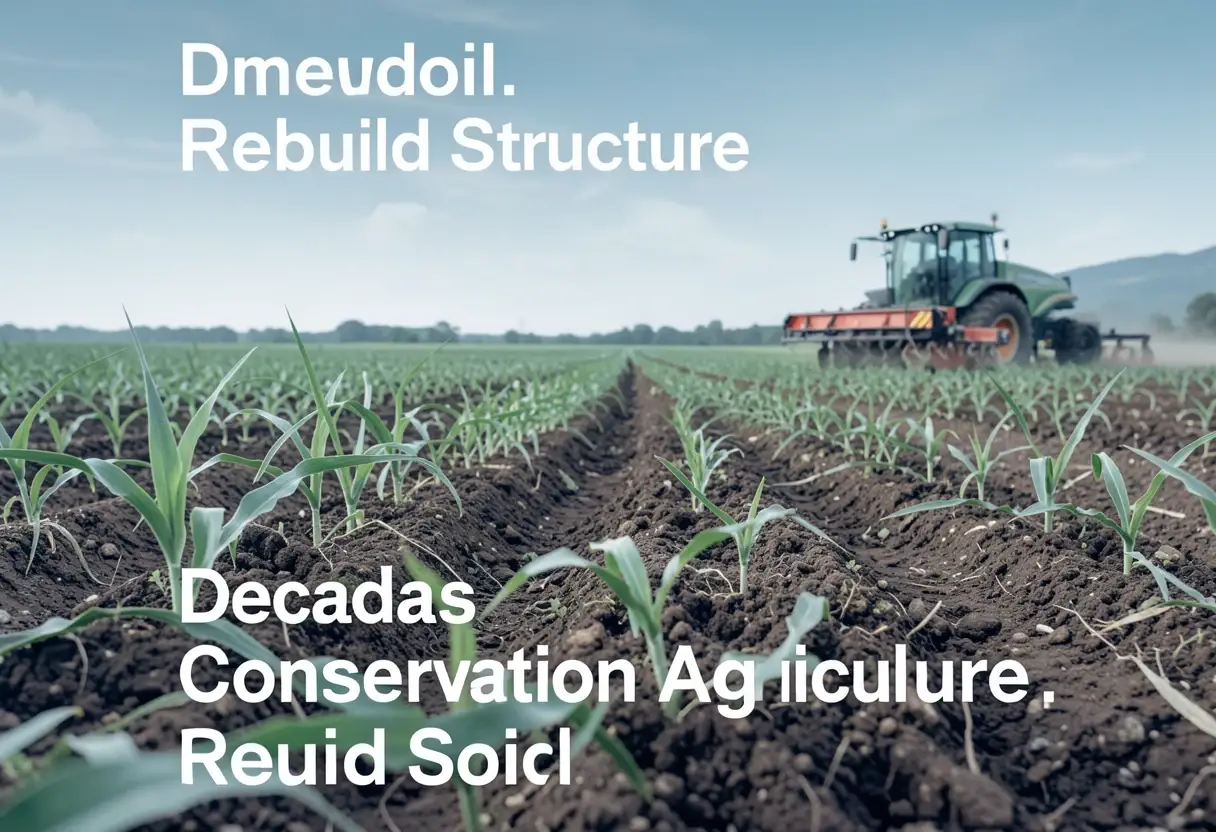
A farm that has stayed with conservation agriculture for two decades has rebuilt its soil structure and doubled the results that matter most to growers, according to a newly surfaced long-term account of the system's performance.
The timeframe is the story. Twenty years is roughly a full generation of cropping, and it is long enough for soil biology, aggregate structure and organic matter to respond to a no-disturbance regime in ways that five-year trials cannot capture. The reported doubling — of soil quality indicators tied to structure — puts a number on what long-term practitioners of conservation agriculture have claimed for years: the soil pays back, but slowly.
What changed over twenty years?
Conservation agriculture rests on three principles: minimal soil disturbance, permanent soil cover and diverse rotations. Applied without interruption, the approach allows aggregates to reform, fungal networks to re-establish and water infiltration to improve season after season.
The long-run data point matters because most trial results in this field cover three to five years. That window is too short to show the structural rebuilding now reported, since aggregate stability and organic matter accumulation respond on decadal timescales. A doubling over twenty years equates to compound improvement of roughly 3.5% per year — modest in any single season, decisive across a career.
For farmers weighing the switch, the arithmetic frames the decision. Early transition years often bring yield drag and weed pressure as the system beds in. The payoff arrives later, in better trafficability, improved water-holding capacity and reduced input costs per hectare.
Why structure is the headline
Soil structure governs nearly everything a farmer manages. Well-aggregated soils drain faster after heavy rain, hold more moisture through drought, and resist compaction from machinery passes. Poorly structured soils do the opposite, and remediation through subsoiling costs fuel, time and money without fixing the underlying biology.
The reported structural recovery under two decades of conservation agriculture suggests the biological route — roots, fungal hyphae and organic binding agents — can do the work that steel cannot. That is the core argument of the system, and the long-term evidence now backs it with a doubling.
What should farmers watch next?
Growers considering the transition should watch for further long-term datasets that separate conservation agriculture's three components, since no-till alone without residue cover or rotation diversity often underperforms. Trial sites publishing decadal comparisons, and machinery makers developing low-disturbance drills suited to high-residue seedbeds, will shape the practical pace of adoption.
The evidence trajectory points one way: the longer the commitment, the larger the measured gain. Twenty years delivered a doubling here — the next cohort of long-term reports will show whether that holds across soil types and climates.
via Google News: crop protection farming (Source)
More from Olivia Hart
Show full bio
News editor covering regulation, policy and their impact on production farming and field operations at Arable Wire.
163 articles
Nearby records
- ZJ 70Study examines how soil cover practices shape soil health outcomesSeptember 29, 2026
- JS 88Regenerative practices cut costs and rebuild soil, Indiana farmer reportsSeptember 29, 2026
- JX 83Soil health practices pay dividends, but only on a long horizonSeptember 29, 2026
- EY 70Better data leads to better soil, growers toldOctober 12, 2026
- FF 38Wolfe family signs on for a century of soil healthSeptember 29, 2026