Rye Cover Crops Trap More Soil Water With Later Termination, UNL Trial Shows
UNL's first-year trial near North Platte shows rye terminated one week after planting stores more soil water, as researchers test cover crops' effect on irrigation and nitrogen.
- Entered
- Plot
- 1.9 ha
- Record
- 750 words
- Walk-through
- 4 min
DrillSprayHarvestCurrent stage
Agronomist’s notes
- UNL drilled two cover crop trials in November at its West Central Research, Extension and Education Center near North Platte, funded by a North Central-SARE grant.
- Terminating the cover crop one week after planting produced more biomass and more stored soil water than termination one week before planting.
- Trials compare a rye monocrop against a five-species mix; rye established fastest.
- The research targets three measures: irrigation savings, nitrogen capture and farm economics.
- Katimbo's N-Mobile Irrigation Testing Lab helps producers adopt data-driven irrigation scheduling technology.
Nebraska farmers pumped less groundwater than they used to — and a first-year University of Nebraska-Lincoln trial near North Platte is testing whether cover crops can slow that decline. Early results point one way: terminating rye one week after planting, not before, stores more water in the soil.
Abia Katimbo, an irrigation management specialist at UNL, drilled two cover crop trials in November at the UNL West Central Research, Extension and Education Center. One plot is a rye monocrop. The other is a five-species mix. Rye established fastest.
The work is funded by a North Central Sustainable Ag Research and Education grant (North Central-SARE), and it attacks three questions at once: irrigation, nitrogen and economics.
"Can the cover crop reduce irrigation and nitrogen requirements, but also do the economics make sense?" Katimbo said.
Why western Nebraska needs the answer
In parts of western Nebraska, pumping capacity has already fallen. "In some areas, farmers have started seeing shortages based on how much they could previously pump onto their fields," Katimbo said.
Groundwater decline is colliding with high input prices. That combination pushed Katimbo's team toward cover crops, which most research suggests can trap off-season precipitation in the spring window before the cash crop needs it.
The stakes for producers are direct. "Farmers are saying, 'Is it even possible to start putting cover crops in my system? Will it ask for more water, or will it cut some water?'" Katimbo said. "The crop needs nitrogen, so they're asking if cover crops will save on fertilizer cost or require more nitrogen."
What does termination timing change?
Everything, so far. The team ran two termination dates: one week before planting the cash crop, and one week after.
Biomass tells part of the story. "We did the first termination one week before planting, and then one week after planting. We are seeing more biomass one week after planting," Katimbo said.
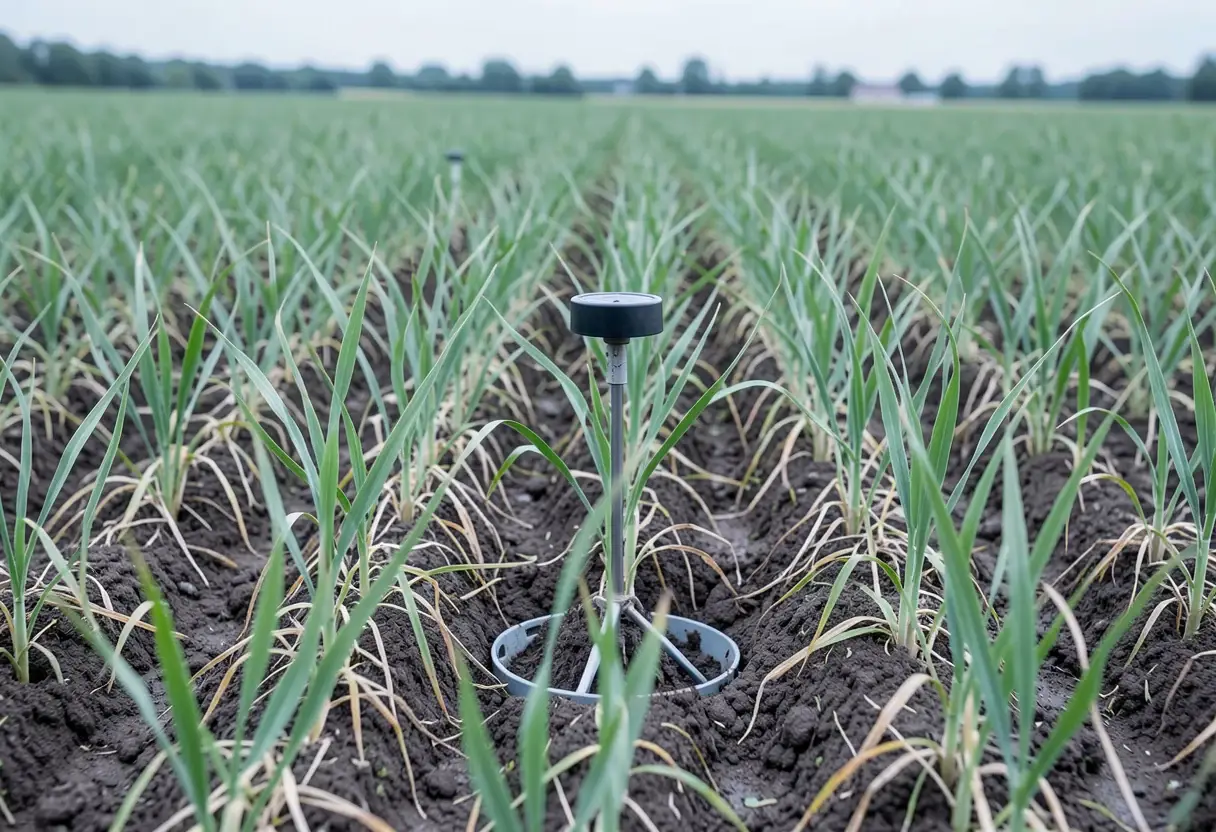
Soil moisture probes — sensors buried in the plot reading water content continuously — confirm the rest. More water sits in the soil profile where termination happened a week after planting.
There's a floor, though. "If you don't have enough biomass, then there's no way that cover crops can capture all water and nitrogen," Katimbo said. Thin stands won't do the trapping job. The team will keep monitoring water requirements of these fields as the trial runs on.
The nitrogen angle
The trial also measures whether cover crops capture excess applied nitrogen before it leaches (washed down through soil) into groundwater. Cover crops take up leftover fertilizer; less of it reaches the aquifer.
"With this study, we are also addressing the current concern of nitrates in drinking water wells," Katimbo said. "High nitrate levels have shown to correlate with increasing cancer cases due to the nitrates in well water."
That gives the research a public-health dimension beyond the field edge — roughly the same link between nitrate contamination and health risk that has driven water-quality regulation in other corn-belt states.
Technology farmers can use now
Cover crops are a multi-year bet. Technology is the immediate lever, Katimbo argues.
He runs an outreach program called the N-Mobile Irrigation Testing Lab, which works directly with producers to improve irrigation efficiency through technology adoption.
"You don't only have to grow the cover crop; you need to have the technology that can give you an estimate of how much the crop is using at different growth stages," Katimbo said. "Farmers need to make decisions based on data."
His message to farmers who must cut water use: get sensors that tell you when and how much to apply, and use them to catch crop stress early. The outreach program also runs the numbers on whether that technology pays for itself in a given operation.
"For sustainable groundwater use management, if you want to actually extend the aquifers' life, we need farmers first to look at regenerative ag practices like cover crops," he said. "But also look at technology that can guide them on how much water the crops actually need."
What to watch next
This is year one of a multi-year trial. Expect biomass measurements, soil moisture data and nitrogen-capture results from subsequent seasons before the economics picture firms up. Farmers weighing cover crops in irrigated corn country should watch the termination-timing finding closely — the one-week-after-planting result, if it holds, changes how a rye cover crop fits a water-limited rotation.
via Farm Progress (Source)
More from Daniel Okafor
Show full bio
Market editor covering money, funding and market shifts around production farming and field operations at Arable Wire.
163 articles
Nearby records
- TR 67Nebraska Opens $2,500 Soil Health Grants; Applications Due Oct 1October 10, 2026
- KP 61Nebraska's Largest Irrigation District Doubles Canal-Fed Pivots Since 2010October 30, 2026
- ZE 21Claas Puts $10 Million Into Nebraska Research CenterOctober 20, 2026
- LT 65Farmers for Soil Health reopens cover crop enrollmentOctober 3, 2026
- HZ 17Nebraska corn yields fall 20-30 bushels as tar spot meets weatherOctober 30, 2026