Nebraska's Largest Irrigation District Doubles Canal-Fed Pivots Since 2010
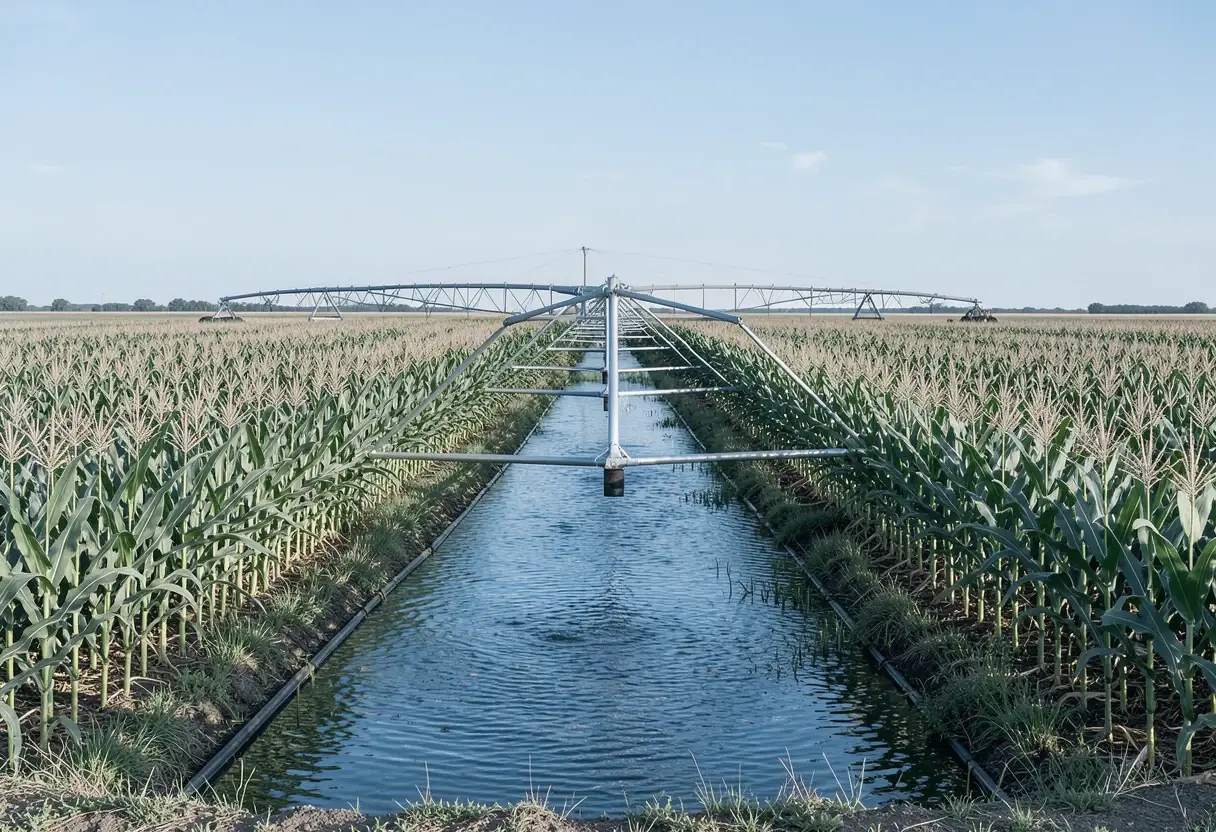
Canal-fed center pivots in CNPPID's Nebraska service area jumped from 348 in 2010 to 769, as 577 miles of canals recharge the Ogallala Aquifer and serve 109,000 irrigated acres.
- Entered
- Plot
- 2.1 ha
- Record
- 839 words
- Walk-through
- 4 min
DrillSprayHarvestCurrent stage
Agronomist’s notes
- Canal-supplied center pivots in CNPPID's service area rose from 348 in 2010 to 769 in the latest season.
- CNPPID delivers surface water to more than 109,000 acres via roughly 577 miles of canals, laterals and pipelines.
- Lake McConaughy releases take seven days to travel from the reservoir to growers' fields.
- Nebraska has over 9 million acres of irrigated ground across nearly 50 irrigation districts.
- Lake McConaughy is Nebraska's second-most visited site, with about 900 lake homes in the district.
By Priya Raman
Center pivots supplied directly by canals in the Central Nebraska Public Power and Irrigation District's service area have more than doubled in 15 years — from 348 in 2010 to 769 in the most recent season. That's the clearest signal of how one Depression-era water network keeps rewriting farm economics in south-central Nebraska.
CNPPID, built in the 1930s and 1940s, is the largest of Nebraska's nearly 50 irrigation districts. It delivers surface water through canals, laterals and pipelines to more than 109,000 acres, plus roughly 100,000 additional acres of supplemental water. Canal-fed pivots now cover about two-thirds of the acres receiving delivery service.
The stakes are geographic. Tom Schwarz farms about 2,000 acres of organic and transitional land in Gosper and Phelps counties with his wife Linda and daughter Becky, in a narrow corridor where annual rainfall drops off sharply. Dryland farming there, he notes, is nearly impossible. The sixth-generation family raises corn, soybeans, wheat, field peas, alfalfa, oats, cover crops and food-grade popcorn, using center pivots, gravity-flood systems and subsurface drip.
"I just can't overemphasize how critical it is for this area to have that surface water that we receive," Schwarz said.
Why the aquifer matters as much as the canals
The district's deepest impact sits underground. Lake McConaughy, Nebraska's largest reservoir, is filled by the North Platte River, which carries Rocky Mountain snowmelt from Colorado and Wyoming plus return flows from upstream irrigation. Four hydro plants — one at Kingsley Dam, three on the supply canal — generate electricity along the way.
"One of the biggest benefits that we see from Central's system is that it actually helps recharge parts of that Ogallala Aquifer," said Talon Mues, Nebraska Extension water and cropping systems instructor. "Central's roughly 577 miles of canals run through an area where that surface water and groundwater are closely connected, right on top of the aquifer."
Nebraska has more than 9 million acres of irrigated ground, and Mues points out the surface and groundwater systems are tightly linked — in part because of CNPPID.
Schwarz is blunter. "If we don't have surface water coming into our area, we wouldn't have our groundwater," he said. "The fact that we have groundwater tables that are where they're at is completely 100% due to CNPPID and the surface water we import into this area. Without that surface water, we're in deep trouble, and we're there pretty quickly."
What does day-to-day management look like?
During the growing season, irrigation service specialists coordinate with producers daily. The control center in Gothenburg runs the hydro plants and every gate structure across the system. If a producer expects water but a rain shower hits, the specialist calls Gothenburg to curtail releases and, where possible, holds water in reserve.
Timing is the hard part. Releases from Lake McConaughy must travel seven days to reach growers. "Trying to predict weather events, and we don't want water to run out the end or get into the river," said Alex Linden, CNPPID's public and government relations manager, who grew up farming with his father in Phelps County. "We have to back that up with our regulating reservoirs, but sometimes you're out of luck."
Maintenance is relentless as structures approach 100 years old. "This year was especially challenging because of the lack of snow," Linden said. "Before we put water in it, our guys spent weeks scooping out cornstalks and debris from the canals."
Automation and recreation on the same water
CNPPID is pushing toward full automation beyond main lines. "We're pretty close to being fully automated, but some laterals aren't automated," Linden said. "If we can get the automation to that, where producers can basically order the water from their phones, that helps maximize the water."
Recreation, an afterthought in the 1940s, is now an economic cornerstone. Lake McConaughy is the second-most visited place in Nebraska, behind the Henry Doorly Zoo, with about 900 lake homes including Johnson Lake and Jeffrey Lake. Balancing lake levels with farm deliveries produces its own comedy: rain on a holiday shuts off irrigation, the lake rises too high for boat docks, then hot wind flips conditions the next day.
Every drop works multiple jobs — recreation, hydropower, cooling at a coal plant, then irrigation. "We're trying to manage that to make sure we maximize every drop," Linden said.
He also notes a cultural shift among growers, from using the full allotment by default to precision irrigation: farmers have learned they may need less water and still maximize yields. Mues said Nebraska Extension, natural resources districts and government agencies must keep working together to keep the state a national leader in irrigation efficiency.
Schwarz's verdict on sustainability is shorter. "The ultimate sustainability is your farm surviving," he said. Watch for CNPPID's lateral automation rollout and next season's canal-fed pivot count as the district nears its centenary.
via Farm Progress (Source)
More from Priya Raman
Show full bio
Senior reporter covering technology and product news in production farming and field operations at Arable Wire.
189 articles
Nearby records
- KM 21Rye Cover Crops Trap More Soil Water With Later Termination, UNL Trial ShowsOctober 30, 2026
- HZ 17Nebraska corn yields fall 20-30 bushels as tar spot meets weatherOctober 30, 2026
- ZE 21Claas Puts $10 Million Into Nebraska Research CenterOctober 20, 2026
- TR 67Nebraska Opens $2,500 Soil Health Grants; Applications Due Oct 1October 10, 2026
- CR 88Lindsay commits $90M to overhaul Nebraska pivot factoryOctober 14, 2026